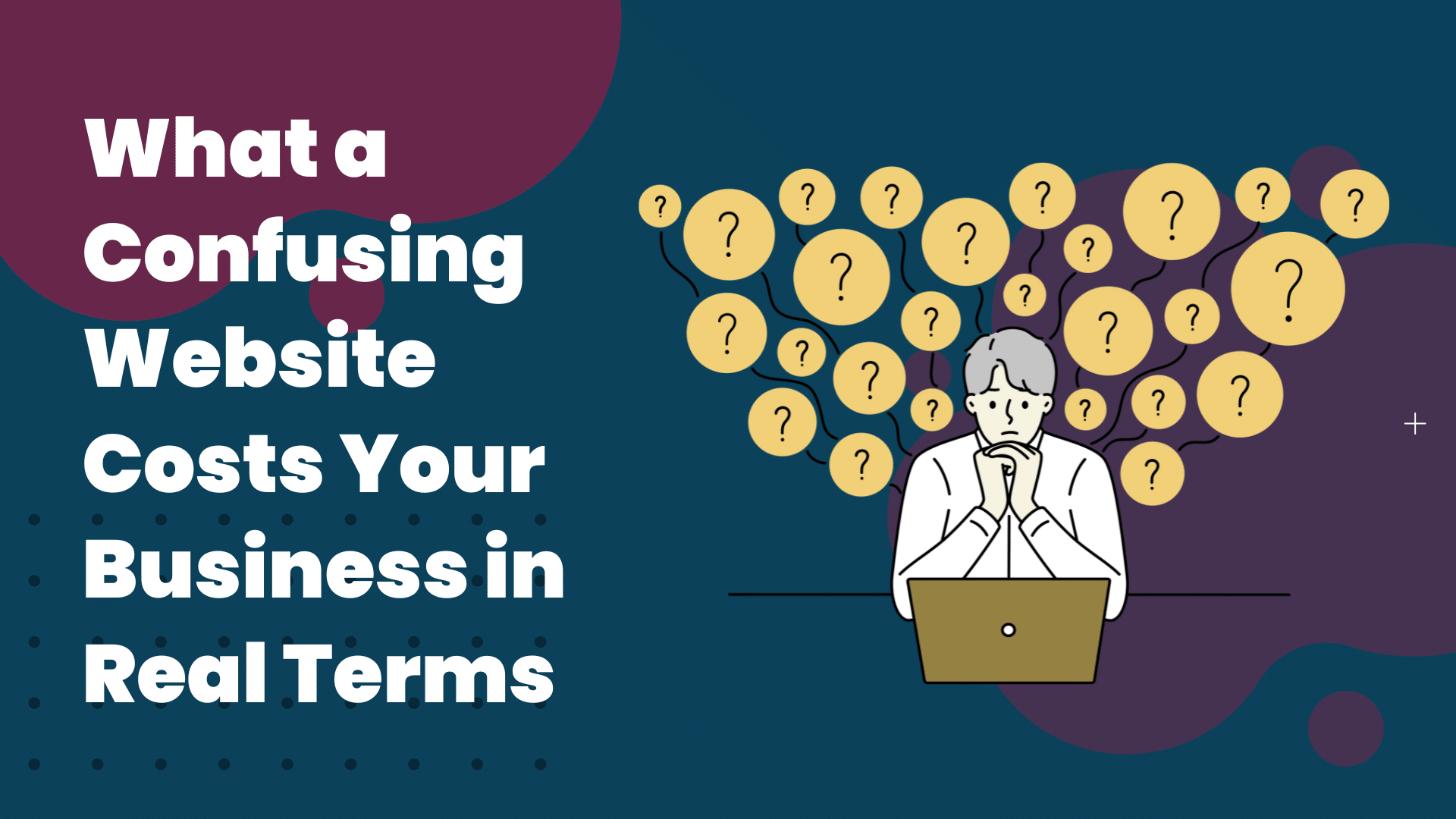
What a Confusing Website Costs Your Business in Real Terms
A confusing website does not just reduce conversions. It affects how people understand your business, how long decisions take, and how much internal effort is required to compensate for what the website fails to explain.
Most businesses underestimate this cost because it is spread across multiple areas. Sales, marketing, operations and leadership all feel the impact, but no single metric captures it fully. The result is a website that appears functional, but quietly underperforms.
Clarity is not a design preference. It is a business requirement.
When a website is unclear, users take longer to understand what the business does and whether it is relevant to them. They read more pages than necessary. They revisit sections. They leave and return later, if they return at all.
Longer decision time reduces conversion rates and lowers lead quality. People who are confident move forward. People who are uncertain delay or disengage.
A clear website reduces the effort required to understand the offer. That reduction directly improves conversion efficiency.
Unclear messaging attracts broad, unfocused interest. People enquire without fully understanding the service, scope or value. This results in more misaligned conversations and more time spent qualifying leads.
Clear positioning acts as a filter. It discourages unsuitable enquiries and encourages better-fit ones. Even if total enquiry volume stays the same, quality improves.
For service-based businesses, this difference has a direct impact on profitability.
When a website does not explain the business clearly, other teams step in to fill the gap. Sales teams repeat the same explanations on calls. Marketing teams create additional content to clarify positioning. Leadership becomes involved in correcting misunderstandings.
This is inefficient. The website should handle first-stage explanation. When it does not, internal time is wasted on tasks that should already be resolved.
Clear websites reduce friction across teams.
Clarity is closely linked to trust. Inconsistent messaging, unclear structure or overloaded pages create doubt. Users question whether the business is organised, experienced or confident in its offering.
This does not require obvious mistakes. Small inconsistencies are enough to weaken credibility.
Trust is easier to maintain than to rebuild. Clear structure, consistent language and intentional design support trust without additional effort.
Internally, unclear websites are harder to manage. Teams are unsure where content belongs. Pages are duplicated instead of updated. Messaging drifts over time because there is no clear framework holding it together.
This increases long-term maintenance costs and makes future changes more difficult. Over time, the website becomes rigid rather than flexible.
Clarity improves scalability.
When a website is clear, several improvements happen at once. Users understand the offer faster. Enquiries become more relevant. Sales conversations start at a higher level. Internal teams rely on the website instead of working around it.
These gains compound. Even small clarity improvements can produce measurable business impact.
This is why clarity delivers a strong return on investment.
Improving clarity is not about adding more content. It usually involves removing unnecessary information, tightening positioning and restructuring how information is presented.
Key areas include:
- Clear definition of who the website is for
- Focused service descriptions
- Consistent language across pages
- Logical page hierarchy
- Design that supports reading and comprehension
Clarity is achieved through alignment, not volume.
Ten10 works with businesses to identify where website clarity breaks down and how that affects performance. We assess positioning, content structure and design together, because clarity issues rarely exist in isolation.
Our approach focuses on making the website easier to understand, easier to maintain and more effective as a business tool. The outcome is not a louder website, but a more efficient one.
If your website attracts traffic but creates friction, clarity is often the issue.
Conclusion
A confusing website creates measurable business costs, even if those costs are not immediately visible. It slows decisions, lowers lead quality, increases internal workload and weakens trust.
Clarity is not cosmetic. It is operational.
If you want your website to perform as a business asset rather than a liability, Ten10 can help you identify and fix clarity issues with a structured, practical approach.
Frequently Asked Questions
Share This Story, Choose Your Platform!
What a Confusing Website Costs Your Business in Real Terms
A confusing website does not just reduce conversions. It affects how people understand your business, how long decisions take, and how much internal effort is required to compensate for what the website fails to explain.
Most businesses underestimate this cost because it is spread across multiple areas. Sales, marketing, operations and leadership all feel the impact, but no single metric captures it fully. The result is a website that appears functional, but quietly underperforms.
Clarity is not a design preference. It is a business requirement.
When a website is unclear, users take longer to understand what the business does and whether it is relevant to them. They read more pages than necessary. They revisit sections. They leave and return later, if they return at all.
Longer decision time reduces conversion rates and lowers lead quality. People who are confident move forward. People who are uncertain delay or disengage.
A clear website reduces the effort required to understand the offer. That reduction directly improves conversion efficiency.
Unclear messaging attracts broad, unfocused interest. People enquire without fully understanding the service, scope or value. This results in more misaligned conversations and more time spent qualifying leads.
Clear positioning acts as a filter. It discourages unsuitable enquiries and encourages better-fit ones. Even if total enquiry volume stays the same, quality improves.
For service-based businesses, this difference has a direct impact on profitability.
When a website does not explain the business clearly, other teams step in to fill the gap. Sales teams repeat the same explanations on calls. Marketing teams create additional content to clarify positioning. Leadership becomes involved in correcting misunderstandings.
This is inefficient. The website should handle first-stage explanation. When it does not, internal time is wasted on tasks that should already be resolved.
Clear websites reduce friction across teams.
Clarity is closely linked to trust. Inconsistent messaging, unclear structure or overloaded pages create doubt. Users question whether the business is organised, experienced or confident in its offering.
This does not require obvious mistakes. Small inconsistencies are enough to weaken credibility.
Trust is easier to maintain than to rebuild. Clear structure, consistent language and intentional design support trust without additional effort.
Internally, unclear websites are harder to manage. Teams are unsure where content belongs. Pages are duplicated instead of updated. Messaging drifts over time because there is no clear framework holding it together.
This increases long-term maintenance costs and makes future changes more difficult. Over time, the website becomes rigid rather than flexible.
Clarity improves scalability.
When a website is clear, several improvements happen at once. Users understand the offer faster. Enquiries become more relevant. Sales conversations start at a higher level. Internal teams rely on the website instead of working around it.
These gains compound. Even small clarity improvements can produce measurable business impact.
This is why clarity delivers a strong return on investment.
Improving clarity is not about adding more content. It usually involves removing unnecessary information, tightening positioning and restructuring how information is presented.
Key areas include:
- Clear definition of who the website is for
- Focused service descriptions
- Consistent language across pages
- Logical page hierarchy
- Design that supports reading and comprehension
Clarity is achieved through alignment, not volume.
Ten10 works with businesses to identify where website clarity breaks down and how that affects performance. We assess positioning, content structure and design together, because clarity issues rarely exist in isolation.
Our approach focuses on making the website easier to understand, easier to maintain and more effective as a business tool. The outcome is not a louder website, but a more efficient one.
If your website attracts traffic but creates friction, clarity is often the issue.
Conclusion
A confusing website creates measurable business costs, even if those costs are not immediately visible. It slows decisions, lowers lead quality, increases internal workload and weakens trust.
Clarity is not cosmetic. It is operational.
If you want your website to perform as a business asset rather than a liability, Ten10 can help you identify and fix clarity issues with a structured, practical approach.